
The AI Adoption Trap: Why Most Initiatives Stall — and How to Avoid It
Executive Summary
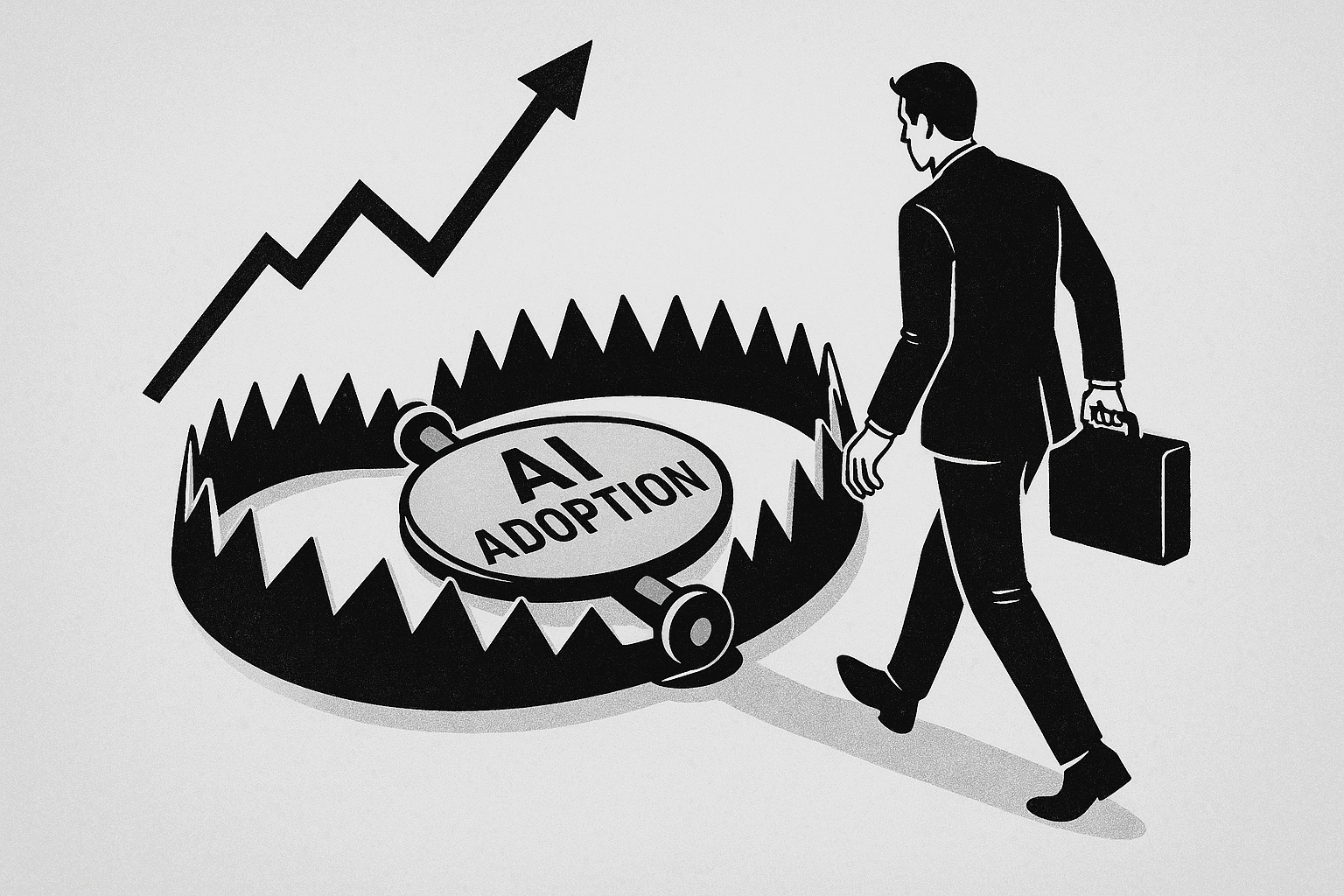
AI adoption is booming in boardrooms but often stalling in break rooms. While executives invest heavily in tools and talent, many initiatives lose steam in the execution phase. This is the AI Adoption Trap: a disconnect between strategic ambition and operational readiness. In this post, we break down the top reasons AI efforts stall and provide a practical framework to help your organization move from hype to value.
Section 1: The Reality — What’s Really Happening in the Market
AI is no longer experimental. It's operational. According to McKinsey, over 55% of organizations have embedded at least one AI capability into their business. Yet, very few are capturing material value from those efforts.
What’s behind the mismatch?
Most companies underestimate the cultural and process changes needed.
Many over-index on technology and under-invest in training.
Leadership often sees AI as an IT initiative, not a business transformation.
This creates a gap between ambition and reality.
Section 2: The Trap — 5 Common Pitfalls of AI Adoption
Shiny Object Syndrome
Teams get excited about the latest model, plugin, or vendor demo. But chasing novelty rarely leads to scalable impact.Tool-First Thinking
Buying software before defining the problem is like buying a hammer and hoping a house appears.Underestimating Change Management
AI transforms workflows and job descriptions. Without intentional buy-in, resistance builds quickly.Lack of Cross-Functional Ownership
AI is not a siloed tech project. Success requires alignment between IT, operations, finance, legal, and HR.Poor Data Foundations
AI needs good data to deliver good results. If your data is a mess, AI will only accelerate the chaos.
Section 3: The Way Out — A Framework for Practical Success
To escape the AI Adoption Trap, organizations need to shift their focus from tech-centric rollouts to business-aligned transformations. Here's how:
1. Start with the Business Problem
Don’t ask "What can AI do?" Ask "What business problem do we need to solve?" Frame AI as a tool to drive outcomes, not innovation theatre.
2. Invest in Your People
Provide role-specific training. From frontline employees to executives, everyone needs a working knowledge of how AI changes their day-to-day.
3. Pilot with Purpose
Start small, but think scale. Use structured pilot programs to prove ROI, then expand with intention.
4. Align Stakeholders Early
Get buy-in across departments. Ensure legal, security, compliance, and HR are involved from Day 1.
5. Build the Data Engine
Prioritize data readiness. A modern data stack isn’t a luxury; it's a prerequisite.
6. Measure What Matters
Define success metrics up front. Measure business outcomes, not just model accuracy.
Section 4: (Optional) Real-World Examples
A healthcare company piloted generative AI to summarize patient records but saw low adoption because doctors weren’t involved in training.
A logistics firm automated contract workflows using RAG (retrieval-augmented generation) and achieved 40% cycle time reduction after a well-executed change management program.
Section 5: Closing Thoughts
AI adoption isn’t a race. It’s a relay. You don’t win by sprinting with the shiniest tools; you win by building trust, empowering teams, and delivering measurable outcomes at every leg of the journey.
Avoiding the AI Adoption Trap requires more than great technology. It demands great leadership.
If you're ready to move from hype to impact, start by asking: What problem are we really solving, and who needs to come along for the journey?
Interested in training your team or building a practical AI adoption roadmap? Let’s talk.
