
Why Your AI Strategy Is Broken (and How to Fix It)
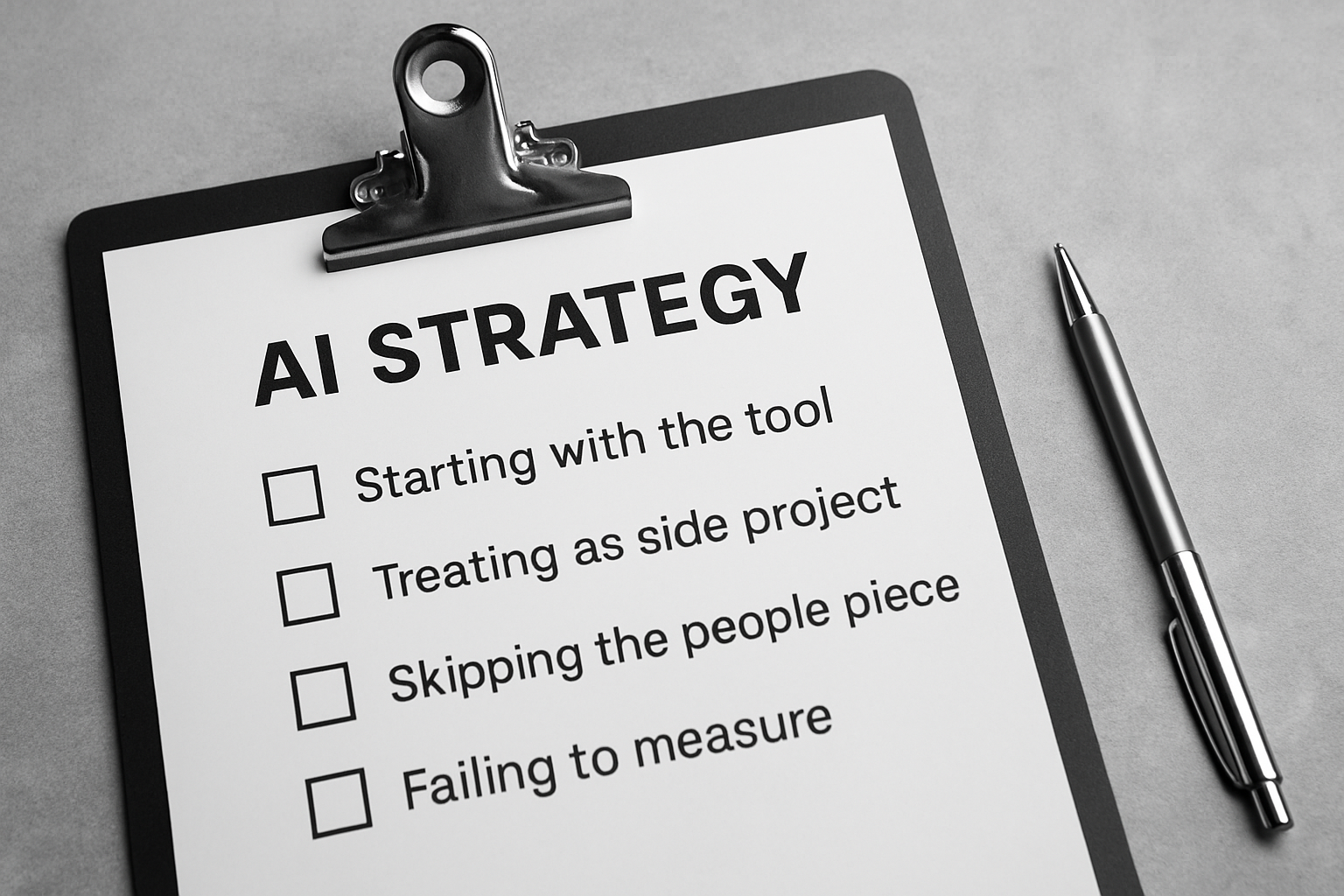
Too many companies treat AI like a shiny object. They launch pilots without a purpose, chase GPT demos with no clear business case, and end up with “AI theater”—a façade of innovation with no real impact.
Sound familiar?
If your AI strategy feels disconnected from business value, you’re not alone. A recent study found that 92% of Fortune 1000 companies are increasing AI investments—yet only 27% have seen measurable ROI.
Here’s why most AI strategies fall short—and what to do instead.
1. Mistake: Starting with the Tool, Not the Problem
Executives often ask, “What can we do with AI?” That’s the wrong question. The right one is:
“Where are our biggest bottlenecks, inefficiencies, or opportunities—and how can AI help?”
The fix:
Start with a business problem. Automate a process. Enhance customer experience. Speed up internal operations. Anchor the solution in impact, not innovation.
2. Mistake: Treating AI as a Side Project
AI isn’t a task for the innovation team to play with. It’s a transformation that touches every part of the business—from data infrastructure to employee workflows.
The fix:
Make AI a cross-functional initiative. Involve IT, operations, legal, and front-line teams early. Treat AI not as a tech layer, but a strategic shift.
3. Mistake: Skipping the People Piece
Employees fear AI. Leadership misunderstands it. Talent is often unequipped to use it. No wonder most adoption efforts stall.
The fix:
Train your team—early and often. Build internal literacy. Create change champions. The best AI strategy is one your people believe in and know how to execute.
4. Mistake: Failing to Measure What Matters
Too many dashboards track model accuracy and latency. But what about customer churn, revenue per employee, or time-to-market?
The fix:
Measure business outcomes, not just technical ones. Tie AI efforts directly to KPIs that your CFO and COO care about. If it doesn’t move a needle that matters, it’s noise.
The New AI Strategy: Practical. Measurable. Human-Centered.
Winning with AI doesn’t require a PhD. It requires clarity:
What problems are you solving?
How will AI accelerate them?
Who needs to be involved?
How will you measure success?
The companies getting this right aren’t necessarily the most advanced. They’re the most intentional.
AI isn’t magic. It’s just math + data + execution.
The faster we get past the hype, the faster we unlock the real value.
